


Medically reviewed by a consultant robotic joint replacement surgeon.
Summary: Mako, Velys, ROSA, and CUVIS are the main robotic knee replacement systems, and all of them use computer guidance to place the implant more precisely than manual surgery. They differ mainly in whether they need a CT scan, how they guide the bone cuts, and their cost. For patients, the surgeon’s experience matters more than the brand of robot. Robotic knee replacement cost in India varies with the system, implant, and hospital.
If you are researching robotic knee replacement, you will quickly run into brand names: Mako, Velys, ROSA, CUVIS, and more. It is easy to assume one must be clearly “the best”.
The reality is more nuanced. These systems are tools, and in skilled hands they aim at the same goal: a well-aligned, well-balanced knee that lasts. Here is how the main systems compare, and what actually matters when you choose.
What are the main robotic knee replacement systems?
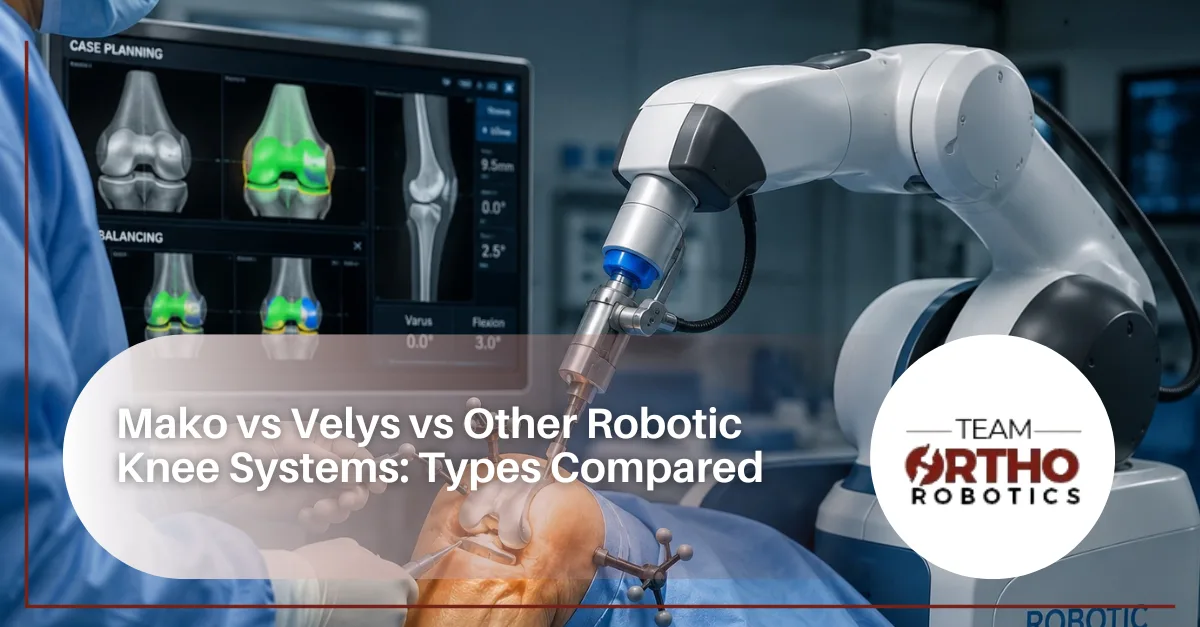
The main robotic knee replacement systems are Mako, Velys, ROSA, and CUVIS, each pairing a surgeon’s plan with robotic or computer assistance to position the implant accurately. They are made by different manufacturers but share the same core purpose.
Here is a simple comparison:
| System | Imaging | Notable feature |
| Mako | CT scan based | Haptic boundaries that guide the cutting tool |
| Velys | Imageless | No pre-op CT, plans from data gathered in surgery |
| ROSA | X-ray or imageless | Uses images and in-surgery data to guide cuts |
| CUVIS | CT scan based | Fully active robot that executes the planned cuts |
Each has strengths, and surgeons often prefer the system they are most experienced with, which is a reasonable basis for choice.
How do these robotic systems actually differ?
The biggest differences are whether the system needs a pre-operative CT scan, and how it guides or performs the bone cuts. These two factors shape the workflow more than anything else.
The main distinctions:
- Imaging: CT-based systems like Mako and CUVIS build a 3D model of your knee before surgery. Imageless systems like Velys map the knee during the operation instead.
- Cutting method: some systems guide the surgeon’s hand within safe boundaries, while others actively perform the planned cut under supervision.
- Open vs closed: some robots work only with one manufacturer’s implants, while others are more flexible.
None of these differences is inherently “better” for every patient. They are trade-offs your surgeon weighs based on your knee and their experience.
Does the robotic system affect the outcome?
Robotic assistance improves the precision of implant alignment compared with manual surgery, and better alignment is linked to smoother movement. But the choice between one robot and another matters far less than the surgeon using it.
The evidence favours precision. Pooled research shows robotic-assisted knee replacement achieves more accurate alignment and better early range of motion than conventional surgery. A separate study comparing robotic and traditional jig-based techniques found comparable or improved early pain and functional outcomes with robotic assistance.
What the research does not show is one brand consistently beating the others. The common thread in good outcomes is an experienced surgeon with a sound plan, whatever system sits in the theatre.
How much does robotic knee replacement cost in India?
Robotic knee replacement surgery cost in India typically runs higher than manual surgery, because it adds advanced technology, imaging, and single-use instrumentation. The exact figure depends on the system, the implant, the hospital, and the city.
The main cost drivers:
- Robotic system and imaging: CT-based planning and robotic instrumentation add to the bill.
- Implant choice: premium implants cost more than standard ones.
- Hospital and city: metro hospitals generally price higher than smaller centres.
- Complexity: revision or bilateral surgery costs more than a single, straightforward knee.
Because of these variables, a written, itemised estimate after consultation is far more useful than any headline price you see online. Ask exactly what is and is not included.
Which robotic system is best for you?
The best system is the one your chosen surgeon uses regularly and trusts, not the one with the most marketing. Patients often fixate on the robot’s brand when the surgeon’s experience is the stronger predictor of a good result.
When choosing, prioritise:
- A surgeon who performs robotic joint replacement routinely.
- Clear, honest discussion of your candidacy and expected outcome.
- Transparent, itemised costs.
Focusing on the team rather than the trademark leads to better decisions. A good orthopedic surgeon on any modern system beats an average one on the “best” robot.
Frequently asked questions
Is Mako better than Velys?
Neither is clearly better for every patient. Mako uses a pre-operative CT scan and haptic guidance, while Velys is imageless and plans during surgery. Both improve precision over manual surgery. The right choice depends on your surgeon’s experience and your specific knee.
Does a robotic knee replacement last longer?
Robotic assistance improves implant alignment, and good alignment supports longevity, but long-term durability also depends on the implant, your weight, and activity. Modern knee replacements already last most people decades, and precise placement helps protect that lifespan.
Is robotic knee replacement worth the extra cost?
For many patients, the improved precision and potential for smoother recovery justify it, but it is a personal decision. Discuss the realistic benefits for your knee with your surgeon rather than assuming the most expensive option is automatically the right one.
Does the robot perform the surgery on its own?
No. The robot assists a surgeon who plans and controls the procedure. Depending on the system, it guides the cuts within safe boundaries or executes a planned cut under the surgeon’s direct control. The surgeon remains fully in charge throughout.
Which robotic knee system is used in India?
Several systems are available in India, including Mako, Velys, ROSA, and CUVIS. Availability varies by hospital. What matters most is choosing a centre with an experienced robotic surgeon rather than selecting a hospital purely by the robot’s brand name.
Robotic knee replacement at Team Ortho Robotics
Because the surgeon and the system work as a pair, the right place for robotic knee replacement is a dedicated, high-volume unit. Team Ortho Robotics offers robotic knee replacement surgery using the CUVIS robotic platform, led by experienced joint replacement surgeons based at Kaushalya Hospital in Thane.
The focus is on precise, personalised surgery backed by honest counselling and transparent, itemised costs, so patients understand both the benefits and the price before deciding. Every plan is built around the individual knee, not a one-size template.
Choosing robotic knee replacement is less about picking a robot and more about picking the right team to use it. If you are weighing your options, get a clear, personalised assessment and an honest cost estimate. Book a consultation with the robotic joint replacement team today.