


Medically reviewed by a consultant robotic joint replacement surgeon | 10 min read
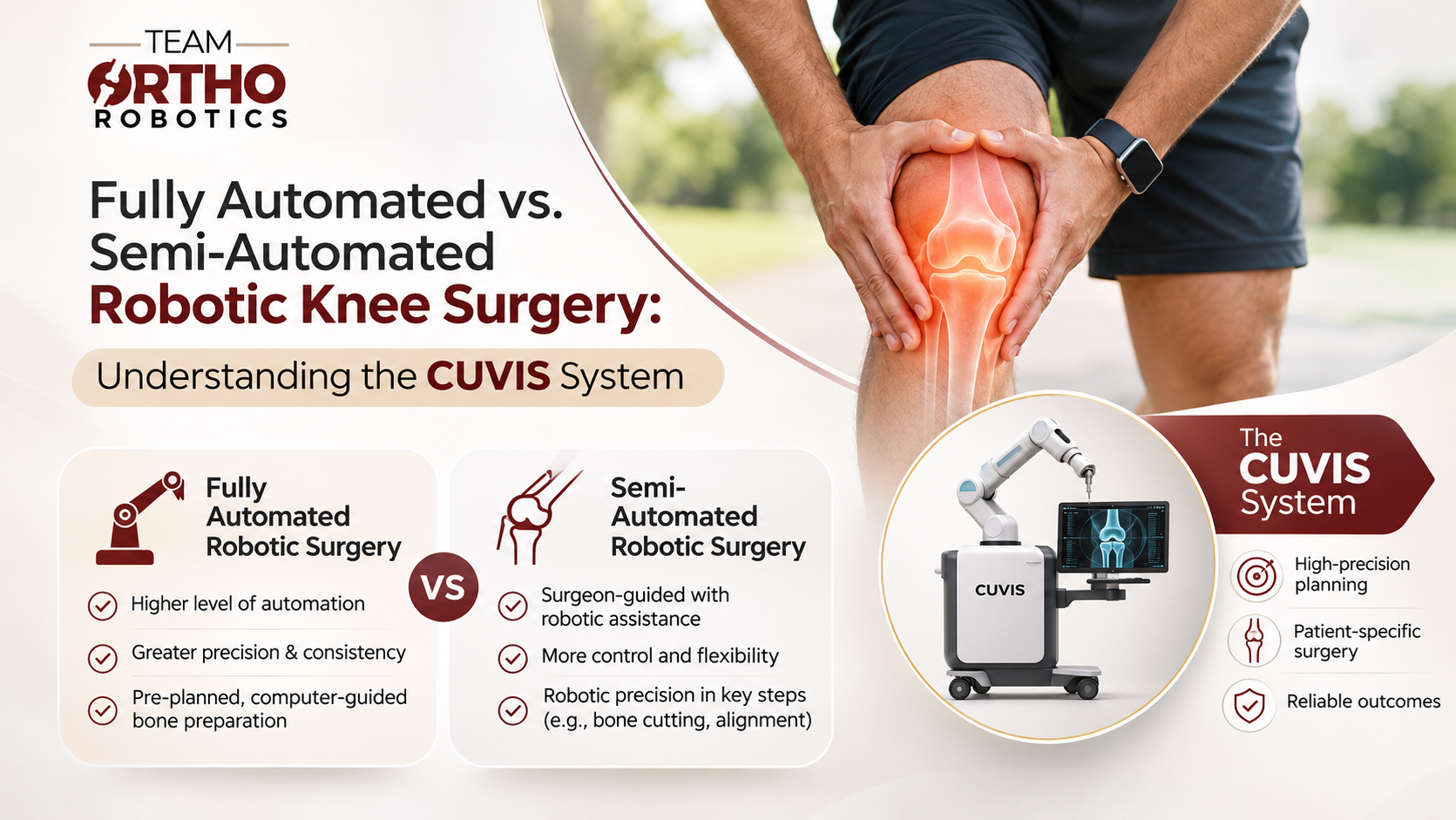
In a fully automated (active) robotic knee replacement, the robot makes the bone cuts itself, following a plan the surgeon has approved. In a semi-automated (semi-active) system, the surgeon holds the saw and the robot guides or limits it. CUVIS is an active system. Robot type is one of several factors behind robotic knee replacement surgery cost in India, along with the implant, the hospital stay and your insurance cover.
Key insights
- The difference is who holds the saw: an active robot cuts to the plan, while a semi-active robot keeps the surgeon’s hand within set boundaries.
- CUVIS is an active system: once the surgeon approves the plan, the robot carries out the femoral and tibial cuts while the surgeon supervises.
- The surgeon still makes every decision: implant size, position, alignment and soft tissue balance are planned and checked by the surgeon.
- Price depends on more than the robot: implant, room, length of stay and insurance sub-limits move the final bill just as much.
Before your consultation
Write down two questions: “Which robotic system will be used on my knee, and what does it do during the operation?” and “Can I have an itemised estimate?” The answers tell you far more than a brand name or a single package price.
If you’ve started reading about robotic knee replacement, you’ve probably run into a lot of brand names and very little explanation. One hospital mentions Mako, another Velys, another CUVIS. Some call their robot “fully automated”. Others say “robot-assisted”. It’s hard to know what any of it means for your knee, or your bill.
This guide explains the difference between fully automated and semi-automated robotic knee surgery, how the CUVIS system works, what the research shows, and how the type of robot fits into the overall cost. By the end, you’ll know which questions to ask at your consultation.
What’s the difference between fully automated and semi-automated robotic knee surgery?
The difference is how much of the bone cutting the robot does. In a fully automated, or active, system, the robot carries out the planned cuts itself. In a semi-automated, or semi-active, system, the surgeon moves the cutting tool and the robot provides guidance and physical boundaries.
How researchers classify knee robots
There isn’t one universal set of labels. A 2025 comprehensive review of robotic systems in knee arthroplasty groups orthopaedic robots into three categories: autonomous, semi-autonomous and teleoperated. You’ll also see the terms active, semi-active and passive. They describe the same idea: how much control the machine has over the cut.
Active (fully automated) systems
The surgeon plans the operation, the robot is registered to your bone, and the robot then performs the femoral and tibial cuts to that plan. The surgeon watches every step and can stop the robot at any moment.
Semi-active (semi-automated) systems
The surgeon holds and moves the saw. The robot tracks the bone in real time and creates a boundary, so the saw can’t cut beyond the planned area. Mako (Stryker) works this way, and Velys (J&J MedTech) is also surgeon-guided.
Passive and navigation systems
These systems give the surgeon real-time information and alignment guidance, but they don’t constrain or perform the cut at all.
| Active (fully automated) | Semi-active (semi-automated) | Passive / navigation | |
| Who makes the bone cuts | The robot, to the approved plan | The surgeon, within robotic boundaries | The surgeon |
| Robot’s role during cutting | Executes the cut | Guides and constrains the saw | Provides information only |
| Surgeon’s role | Plans, approves, supervises, can stop | Plans and cuts | Plans and cuts |
| Example systems | CUVIS-joint | Mako, Velys | Computer navigation |
How does the CUVIS system work?
CUVIS-joint, made by Curexo, is an active robotic system. The surgeon builds a personalised plan from your pre-operative imaging, the robot is registered to your knee in theatre, and then it performs the bone cuts to that plan while the surgeon supervises.
Step 1: Imaging and planning
Before surgery, your knee is imaged and a 3D plan is built for your bone shape. The surgeon decides implant size, position and alignment, and adjusts the plan to suit your knee.
Step 2: Registration in theatre
In theatre, the robot’s tracking system maps your actual bone to the plan, so the machine knows exactly where your knee is in space.
Step 3: Robotic bone cuts
Once the surgeon approves, the robot makes the femoral and tibial cuts to the plan. The surgeon watches throughout and can pause or stop the robot at any time.
Step 4: Surgeon checks and implant placement
The surgeon checks the cuts, assesses the soft tissues and ligament balance, places the implants and closes the wound. These steps still depend on the surgeon’s judgement and experience.
Why “fully automated” doesn’t mean “surgeon-free”
It’s easy to read “fully automated” as “the robot does the operation”. It doesn’t. The robot carries out one precise task, the bone cuts. Everything that decides how your knee will feel, from the plan to the balance and the closure, is still down to the surgeon.
What does the research say about active robots like CUVIS?
The evidence for CUVIS specifically is early but encouraging on accuracy. The larger question, whether active robots give better long-term results than semi-active ones, hasn’t been settled yet.
Accuracy in the lab
A cadaveric study of the CUVIS Joint system found that bone cuts were within 1.0 mm of the planned depth and within 1.0 degree of the planned angle, on average. That’s a laboratory study on six knees, and it was funded by the manufacturer, so it shows the machine can follow a plan closely. It doesn’t prove better outcomes in patients.
What we don’t know yet
Long-term studies comparing active and semi-active robots on pain, function and implant survival are still limited. Most robotic knee research so far has been on semi-active systems, simply because they’ve been in wider use for longer.
What this means for you
Accuracy is a strong reason to choose robotic surgery, but it’s not the only factor. Your surgeon’s experience, the plan, the implant and your rehabilitation matter just as much.
Fully automated or semi-automated: which is better for you?
Neither type is better for every patient. Both can deliver an accurate, well-aligned knee replacement in experienced hands. The better question is which system your surgeon uses routinely, and why.
What active systems offer
The cut follows the plan very precisely, and it doesn’t depend on how steady the surgeon’s hand is on the day. Some surgeons also prefer the consistency of a robot carrying out the cut the same way every time.
What semi-active systems offer
The surgeon keeps a feel for the bone while the robot prevents over-cutting. Many surgeons value that hands-on control, and these systems have a longer track record in published research.
What matters more than the robot
The surgeon’s experience and case volume, how well the plan fits your knee, implant choice, soft tissue handling and your physiotherapy all shape your result at least as much as the robot type.
How does the robot type affect robotic knee replacement surgery cost in India?
Robot type can affect the price, but it’s only one part of the bill. The total cost of robotic knee replacement in India depends on the hospital, the implant, the length of stay, tests and physiotherapy, and how much your insurance covers.
What goes into the bill
| Cost component | What it covers | Why it varies |
| Robotic technology | Use of the robot, planning, consumables | System type and hospital pricing |
| Implant | The knee components | Brand, design and material |
| Surgeon and anaesthesia fees | The operating team | Experience and complexity |
| Hospital stay | Room, nursing, medicines | Room category and length of stay |
| Investigations | Imaging, blood tests, pre-op checks | Your health and the planning scan |
| Physiotherapy | In-hospital and early rehab | Number of sessions |
Insurance is often the deciding factor
India performs an estimated 2.5 lakh to 3.5 lakh joint replacement surgeries every year, and insurance is one of the biggest barriers to choosing robotic surgery. Business Today reports that some insurers treat the robotic component as an additional technology cost rather than an essential medical expense, so patients may pay the difference themselves. Check your policy’s sub-limits for modern treatments before you book.
Comparing quotes fairly
Two quotes for “robotic knee replacement” can cover very different things. Ask each hospital for an itemised estimate showing the implant, room type, number of days and what happens if you need to stay longer. Our cost comparison of robotic and traditional knee replacement explains how to read one.
Robotic surgery cost in India beyond the knee
The same logic applies to robotic surgery cost in India more broadly. The robot is a large investment for the hospital, but what you pay is shaped mainly by the procedure, the implant or consumables, the stay and your insurer.
What should you ask your surgeon about the robot?
These questions turn a confusing brand conversation into a useful one:
- Which robotic system will you use, and is it active or semi-active?
- What will the robot do during my operation, and what will you do?
- How many robotic knee replacements has your team done?
- How is my plan built, and can I see it?
- What’s included in the estimate, and what isn’t?
- How much of this will my insurance cover?
For a wider look at the systems on the market, see our guide to the different types of robotic knee replacement.
How does Team Ortho Robotics use CUVIS?
Team Ortho Robotics uses the CUVIS robotic system for robotic knee replacement surgery at Kaushalya Medical Foundation Trust Hospital, Thane. The team describes its set-up as Thane’s first fully automated robot.
Each patient’s plan is built from pre-operative assessment and imaging before surgery is scheduled. Dr Kiran Kumar Bhavnani, Dr Sameep Sohoni and Dr Jayesh Nayak together have performed more than 10,000 knee and hip joint replacement procedures over twenty years, and they plan and supervise every robotic case.
Wrapping up
Fully automated and semi-automated robots both aim for the same thing: a knee replacement that matches a precise plan. The difference is who holds the saw. With CUVIS, the robot makes the cuts and the surgeon plans, approves and supervises.
When you’re comparing robots and prices, keep the focus on the surgeon, the plan and an itemised estimate. If you’d like to understand which approach suits your knee, book a consultation with Team Ortho Robotics in Thane.
FAQs
What is a fully automated robotic knee replacement?
It’s a knee replacement where an active robot performs the bone cuts to a plan the surgeon has approved. The surgeon builds the plan, supervises throughout and can stop the robot at any time. CUVIS-joint is an example.
Is CUVIS better than Mako or Velys?
No system is proven better for every patient. CUVIS is active and cuts to the plan, while Mako and Velys are surgeon-guided. Lab studies show CUVIS is highly accurate, but long-term comparisons are still limited.
Does the robot perform the whole surgery?
No. In an active system, the robot carries out the bone cuts only. The surgeon plans the operation, approves it, checks the cuts, balances the soft tissues, places the implants and closes the wound.
What is the robotic knee replacement surgery cost in India?
It varies by hospital, city, implant, room type, length of stay and insurance cover. Ask for an itemised estimate after assessment, and check your policy’s sub-limits, since some insurers don’t fully cover the robotic component.
Does insurance cover robotic knee replacement in India?
Often partly. Some insurers cover the surgery but treat the robotic component as an additional technology cost, and some policies apply sub-limits to modern treatments. Check the policy wording and confirm with your insurer before admission.
Is a fully automated robot safe?
Active robots are used under constant surgeon supervision, and the surgeon can stop the robot at any point. As with any surgery, safety depends on proper planning, an experienced team and good post-operative care.