


Summary
If one knee was replaced traditionally five years ago, the other knee can often still be treated with robotic assistance. The key question is not the old surgery itself. It is whether your current knee, bone quality, ligaments, and overall health suit the plan. Robotic-assisted TKA has shown better reproducibility in implant planning and fewer positioning outliers in recent studies.
Introduction
If your first knee replacement was done traditionally, you may now wonder about the other side. That is a sensible question. According to a 2024 cohort study, robotic-assisted total knee arthroplasty produced more reproducible insert thickness and fewer outliers than manual or navigation-assisted surgery.
Many people want a smoother recovery the second time around. Others want better alignment and a more tailored fit. The worry is usually the same. Will the previous operation limit the new one? That concern is common, and it deserves a clear answer.
This blog explains when robotic assistance may still be suitable, what decides candidacy, and what results you can realistically expect. It also helps you prepare for a discussion with an orthopaedic surgeon in Thane.
Can the other knee be replaced with robotic assistance now?
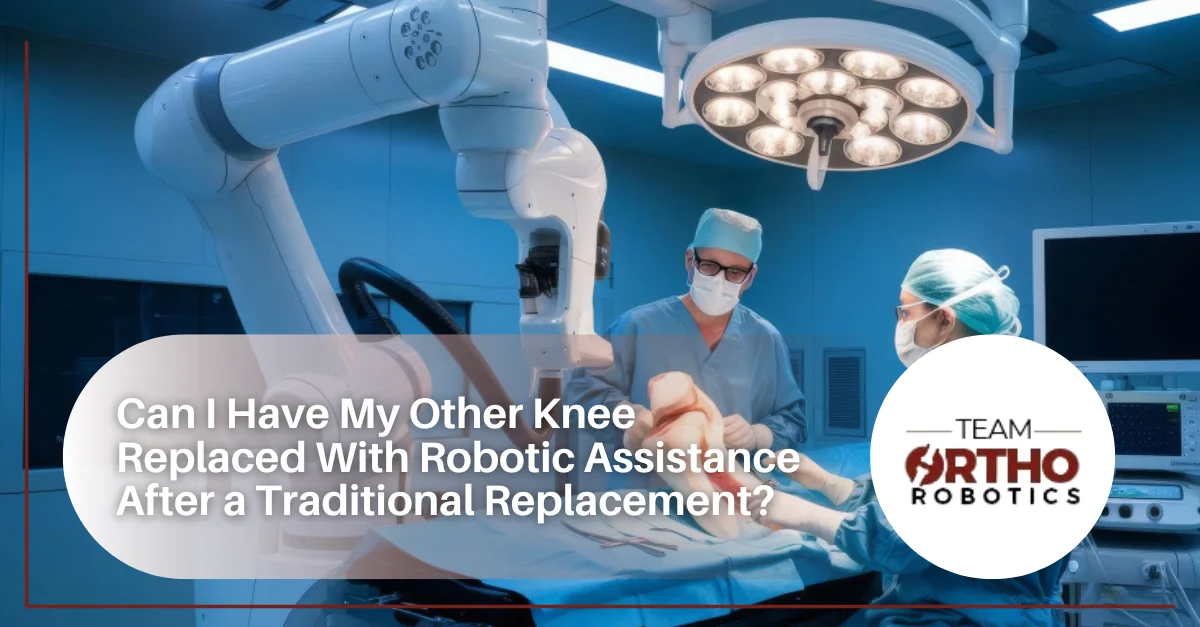
Yes, often it can. A previous traditional replacement on the opposite knee does not automatically rule out robotic surgery on the second knee. The decision usually depends on the knee being treated now, not the old implant on the other side. That is a practical inference from how robotic TKR is planned around the current anatomy.
Robotic systems are designed to help surgeons plan bone cuts and implant position more precisely. They also support a more personalised fit. In modern knee replacement, that can matter more than the method used on the first knee.
A surgeon will still review your full joint history. They will check whether your arthritis has progressed, whether the knee is deformed, and whether your muscles and ligaments are stable enough.
What the surgeon is really looking for
The assessment is usually simple and focused. It may include:
- Current X-rays and alignment scans
- Bone quality around the knee
- Ligament balance and joint stability
- Skin condition and scar tissue
- Medical fitness for anaesthesia and surgery
- Any hardware, infection history, or prior injury in the same limb
These checks matter because robotic assistance is a planning tool. It does not replace surgical judgement.
Why choose robotic assistance for the second knee?
For many patients, the main appeal is precision. Robotic-assisted TKA has been linked with better reproducibility in component planning and fewer alignment outliers. In one 2024 study, the rate of thicker insert use was much lower in the robotic group than in manual surgery.
It can also support a more customised operation. The surgeon uses the technology to match the implant to the knee’s unique shape and movement. That can help when the knee is stiff, uneven, or more complex than expected.
Another point matters for patient expectations. Precision does not always mean a dramatic difference in every outcome. A 2024 registry analysis found similar two-year revision rates between conventional and robotic-assisted cementless TKA. That means robotics may improve accuracy, yet long-term success still depends on many factors.
Robotic vs traditional knee replacement for the second knee
| Feature | Traditional surgery | Robotic-assisted surgery |
| Planning | Surgeon-led, manual measurements | Digital planning with robotic guidance |
| Implant placement | Reliable, but more dependent on manual technique | More reproducible positioning in some studies |
| Soft-tissue balancing | Surgeon adjusted during surgery | Surgeon adjusted with robotic feedback |
| Personalisation | Good | Stronger focus on individual anatomy |
| Revision risk | Depends on many factors | Similar short-term revision rates in one 2024 analysis |
This comparison is not about “better” or “worse” in every case. It is about fit. The right option depends on your knee, your goals, and your surgeon’s judgement.
What decides whether you are a candidate?
The best candidates are usually people who need a new knee for pain, stiffness, deformity, or loss of function. The previous surgery on the other knee is only one part of the story. The current joint matters more.
The main checks before surgery
A surgeon may ask:
- How bad is the pain in daily life?
- Can you walk, climb stairs, and stand safely?
- Is the knee bowed, stiff, or unstable?
- Do you have diabetes, heart disease, or anaemia?
- Have you had infection, fracture, or major surgery in the same leg?
- Are you recovering well from the first knee replacement?
If the answer to most of these is favourable, robotic surgery may be considered. If not, the surgeon may advise a different plan. The final decision should always come from a detailed clinical assessment.
How does recovery compare after robotic knee replacement?
Recovery varies from person to person. Some patients go home the same day. Others stay one to three days, depending on pain control and mobility. That depends on the recovery plan chosen by the surgeon.
Some patient-facing material reports earlier improvement in range of motion and function with robotic-assisted surgery compared with traditional replacement. One recent summary also notes faster recovery in selected studies. Still, recovery speed depends on physiotherapy, fitness, and wound healing.
What usually helps recovery most
- Starting physiotherapy early
- Keeping the wound clean and dry
- Managing swelling well
- Walking as advised
- Following the medication plan carefully
- Returning for review on time
A good recovery is not only about technology. It is also about discipline after surgery.
What should you ask an orthopaedic surgeon in Thane?
If you are comparing options in Thane, ask direct questions. A skilled orthopaedic surgeon in Thane should explain the plan clearly and in plain language. The best orthopedic doctor in Thane for you is the one who listens well and matches the treatment to your knee.
Questions worth asking before you decide
- Am I a good candidate for robotic-assisted surgery?
- Will my old traditional replacement affect this surgery?
- Which robotic system will be used for my knee?
- What are the expected benefits in my case?
- What recovery timeline should I expect?
- How many follow-ups and physiotherapy sessions will I need?
If the answers are specific, clear, and practical, that is a good sign. Good planning often leads to better confidence before surgery.
Frequently asked questions
Can I have robotic surgery if my first knee was done traditionally?
Yes. A previous traditional replacement on the other knee does not usually block robotic surgery. The surgeon will focus on the current knee, your health, and your anatomy.
Will robotic surgery make recovery much faster?
Sometimes recovery is smoother, and some studies show earlier function. But recovery still depends on physiotherapy, pain control, and your general health.
Does robotic surgery guarantee better long-term results?
No. It can improve precision, but it does not guarantee a lower revision rate. A 2024 analysis found similar two-year revision rates.
Is robotic knee replacement suitable for complex knees?
It may be useful in complex cases because it supports planning and balancing. Your surgeon must still confirm whether your knee anatomy and medical condition are suitable.
Conclusion
Yes, the other knee can often be replaced with robotic assistance even if the first one was done traditionally. The old surgery is usually not the main barrier. Your present knee condition and overall fitness matter more. Robotic-assisted TKA offers precision, personalisation, and strong planning support, while outcomes still depend on expert surgical care.
If you are exploring robotic knee replacement surgery with a trusted orthopaedic surgeon in Thane, Team Ortho Robotics can help you understand the right option for your knee. Book an appointment and get a clear, personalised opinion before you decide.